


Summary
A month after its site went live, Kerasmile is cited by AI assistants on keratin. No ads, no large-scale link building, and no attempt to win the whole toothpaste category at once: a well-built site by Forgeone, articles that answer the questions patients actually ask, and a single product angle worked with Refine, one the brand almost has to itself. Here is why that is the right way to start a site.
Why the Way a Site Is Built Decides Its AI Visibility
A growing share of patients no longer type “toothpaste for sensitive teeth” into Google. They ask ChatGPT: “Which toothpaste should I use to protect my enamel after whitening?”. The AI does not return ten links. It writes an answer and names two or three brands. If yours is not one of them, you do not exist.
To decide who to cite, AI assistants read the web. They go through pages, pull out facts and cross-check them. A good-looking but badly built site is unreadable to them: text locked inside images, decorative headings, slow pages, no structured data. A well-built site gives them information that is clear, ordered and verifiable.
Key takeaway
GEO is about becoming the source AI assistants understand, trust and recommend. It starts with the site’s code, not with advertising.
Six Foundations of a Site AI Can Read
AI visibility cannot be bolted on afterwards. It is set in the foundations, from the first line of code.
- Clean HTML semantics: one H1, logical H2s and H3s, article and section tags used for what they are. For an AI, the HTML structure is the outline of the document.
- A focused topic: one page per intent, written in the patients’ own words (worn enamel, sensitivity to cold, care after whitening). The AI then links the brand to the questions it is asked.
- Structured data: Organization, Product, Article and FAQPage in JSON-LD say plainly who you are and what you sell.
- Quotable facts: ingredients, doses, price and stockists written as text. An AI quotes facts, not slogans.
- Fast pages: light pages, rendered on the server. Content that only appears once JavaScript runs may never be read by AI crawlers.
- Open indexing: an up-to-date sitemap and a robots.txt that lets GPTBot, ClaudeBot and PerplexityBot in. You cannot be cited if you are not read.
How Forgeone Built the Kerasmile Site
Kerasmile is a French keratin toothpaste designed to protect and strengthen enamel. It combines hydrolysed keratin, hydroxyapatite, fluoride (1,450 ppm), xylitol, zinc and panthenol. It is certified Origine France Garantie, SLS-free, and sold for €12.80 in pharmacies. A young brand, up against giants that have been around for decades.
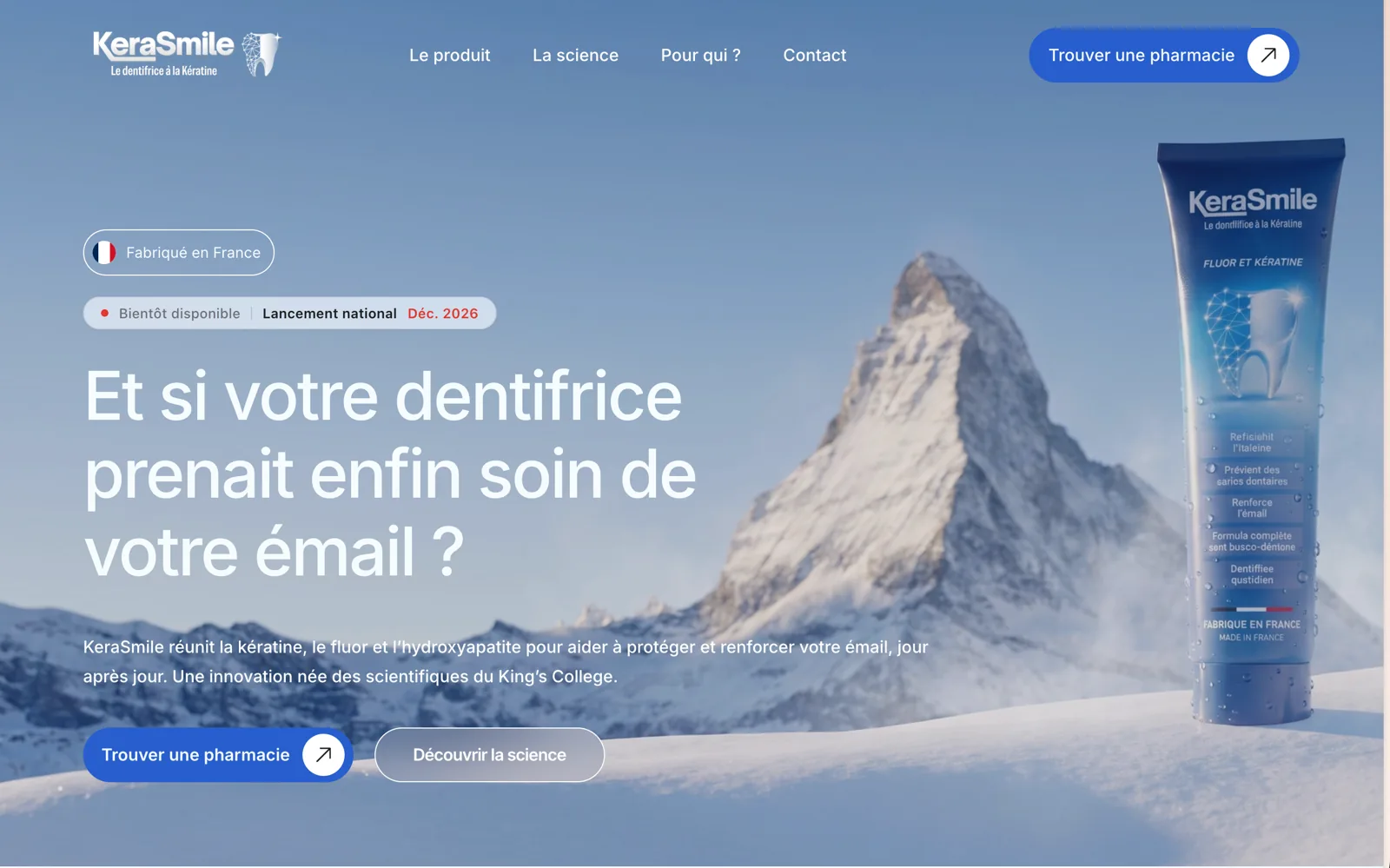
Kerasmile trusted its site to Forgeone, a Paris agency founded by Pierre-Louis Mercier that builds sites designed for search. Its principle: put clients where their customers are searching. Today, their customers also search in AI assistants.
The whole brand fits in one question: “What if your toothpaste finally took care of your enamel?”. Rather than covering everything, the site owns a single topic, in depth. Its La science section gathers every article in one category, “Enamel & sensitivity”.
On the technical side, the site is built to be read by crawlers as well as patients: one H1 per page and a consistent H2 hierarchy, JSON-LD structured data (Organization and WebSite across the site, FAQPage on the home page, BlogPosting, BreadcrumbList and FAQPage on every article), server-rendered content that reads without JavaScript, a robots.txt that blocks no AI crawler, and an up-to-date sitemap.
Six Articles That Answer Patients’ Questions
In September 2026, the site published six articles, in French. Each one takes, word for word, a question patients ask Google or an AI:
- Émail dentaire usé : que faire ? Symptômes et solutions, answering “My enamel is worn, what can I do?” (September 9).
- Dentifrice reminéralisant : ça marche ? Comment choisir, answering “Which remineralising toothpaste should I choose?” (September 10).
- Dents sensibles après un détartrage ou un blanchiment : est-ce normal ?, answering “Why do my teeth hurt after whitening?” (September 11).
- Réparer l’émail dentaire : est-ce vraiment possible ?, answering “Can tooth enamel be repaired?” (September 12).
- Reminéraliser les dents : est-ce vraiment possible ?, answering “Can you remineralise your teeth?” (September 13).
- KeraSmile : le dentifrice à la kératine pour votre santé buccale, answering “What is a keratin toothpaste?” (September 29).
These articles share a structure built for human readers and machines alike. The one on worn enamel is a good example:
- A title phrased as a question, the way people actually search.
- A seven-part table of contents where every heading is also a question.
- A “causes → solutions” table: a block of facts an AI can lift as it is.
- “Key takeaway” boxes that sum up the essentials in one sentence.
- A six-question FAQ that covers the variations of the main query.
- Links between the articles on enamel, keratin, hydroxyapatite and sensitivity, which show search engines the site covers its topic fully.
- Sourced facts: fluoride dose, price, stockists, and a study published in 2025 in Advanced Healthcare Materials by a team at King’s College London.
Key takeaway
A site AI assistants cite is a clear topic, pages that answer real questions, and answers structured in blocks that are easy to quote.
One Angle to Start With: Keratin
A new site has no history, no links and no reputation. If it goes straight for “best toothpaste”, it runs into brands that have owned those answers for years. AI assistants cite what they see confirmed across the web, and a brand a few weeks old carries no weight on a query that broad.
With Kerasmile, we did the opposite: work one product angle, the one that sets it apart, keratin. Very few toothpastes are built around this ingredient, so few sources talk about it. On that ground, a young brand can become the obvious answer.
That is the job of the article KeraSmile : le dentifrice à la kératine pour votre santé buccale, published on September 29. It explains what a keratin toothpaste is, what it does for enamel and which studies back it. The articles on enamel and remineralisation link to it.
In practice, working one angle means:
- Pick the feature that sets the product apart, not the whole category.
- Write the page that explains that angle better than anyone, with facts AI assistants can quote.
- Link the site’s other articles to that page, so AI assistants tie the brand to the topic.
- Track that angle’s questions every day before opening new ones.
Key takeaway
At the start, a site does not win a category. It wins an angle. From that position, it can then go after the more contested queries.
What One Month on Keratin Gave
From launch, Kerasmile was connected to Refine. Every day, Refine asks AI assistants questions about keratin toothpaste and records which brands they name.
Four weeks after launch, ChatGPT names Kerasmile first when asked “What is the best keratin toothpaste?”. It repeats the ingredients and points to kerasmile.fr as its source.
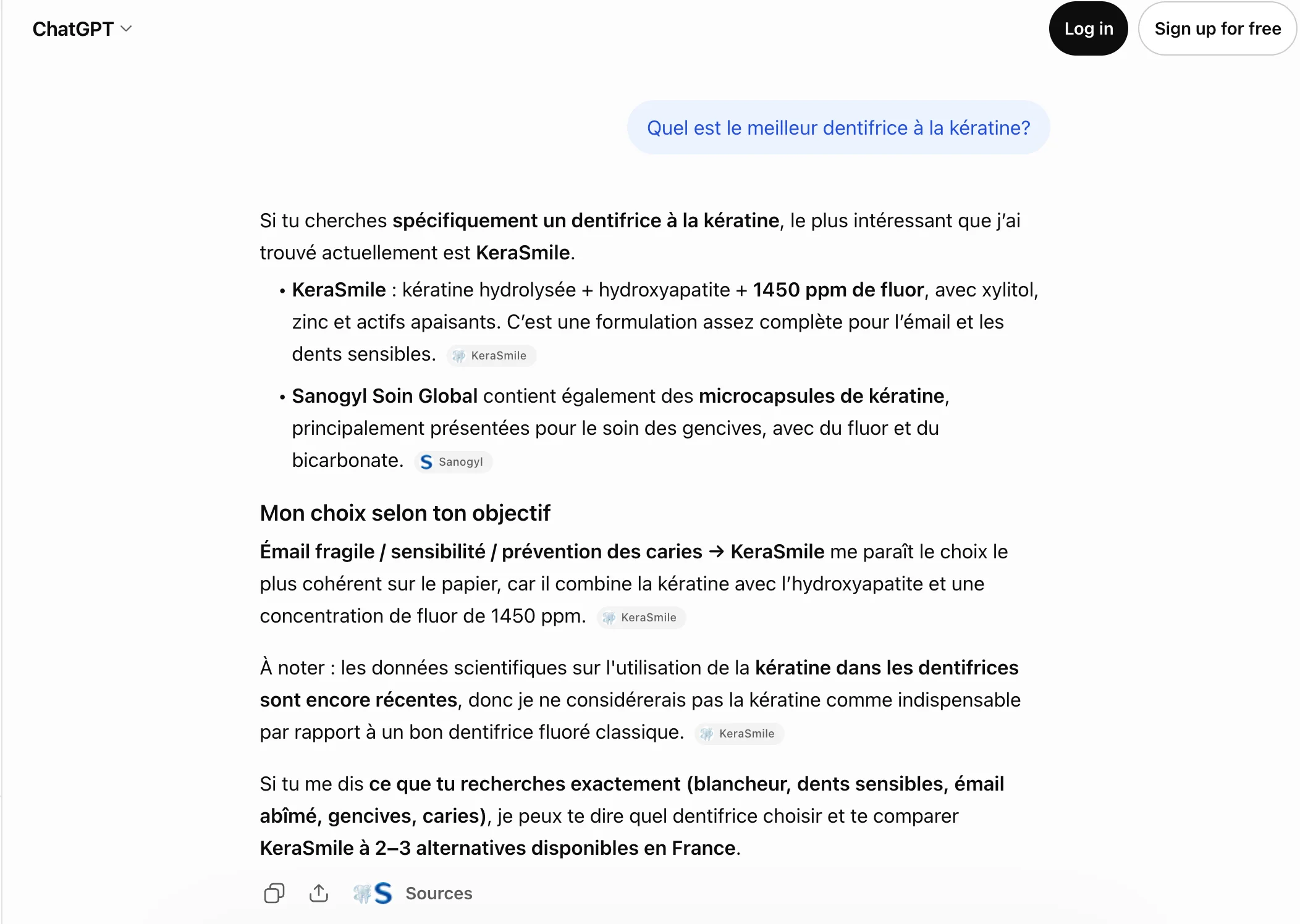
For a brand starting from zero, with no history and no online reputation, it shows the angle was the right one: on a topic few others cover, a handful of well-built pages is enough to become the source.
From 0 to 1
Going from an invisible brand to one AI assistants cite on one angle is the hardest step. Once that angle is held, you can open a second one.
Only the Beginning: Forgeone × Refine
A well-built site opens the door. What comes next decides how far the brand goes. Forgeone builds the foundations. Refine measures, spots the openings and feeds the brand with content AI assistants want to cite.
- Open the neighbouring angles: once keratin is held, track broader, more contested questions, such as best toothpaste for enamel, hydroxyapatite, SLS-free toothpaste.
- Close the blind spots: find the questions where competitors are cited and Kerasmile is not, then write the missing article in the “Enamel & sensitivity” section.
- Feed the sources AI assistants read: health media, comparison sites, forums. Refine identifies these sources so Kerasmile can be present there.
- Measure every gain: each published article is tracked to check it moves visibility.
Our goal is simple: in a few months, when someone asks an AI how to look after their enamel, Kerasmile should be the first answer.
Is Your Site Ready for AI?
- Every page has one H1 and a logical heading hierarchy.
- Your site starts with one angle where it can be the obvious answer, covered in depth.
- Your articles answer real questions, phrased the way your customers ask them.
- Key facts (price, ingredients, where to buy) are written as text.
- Organization, Product, Article and FAQ structured data are in place.
- The site loads fast and reads without JavaScript.
- AI crawlers are allowed in robots.txt.
- Your AI visibility is measured from day one.
In short
A new brand does not need to win its whole category to be cited by AI assistants. It needs to win one angle first, with a site they understand. Forgeone builds the foundations, Refine picks the angle and measures every gain.
Short on time? Have an assistant summarise this page for you.