


Summary
Corma sells license, access and SaaS spend governance to mid-market IT teams. In that category, the shortlist decides everything. An IT lead at a 600-person company used to open ten tabs. Now they ask an assistant which tools to look at, and they work from the four or five names it gives them. Corma launched in 2023, against competitors who had spent years accumulating reviews and directory listings. Six months into working with Refine, inbound was up more than 50%, and about a third of it was coming from generative engines.
Why this matters
SaaS management gets bought by a technical committee after weeks of research. That group moved to AI assistants faster than almost anyone. And an assistant does not send you traffic, it decides who gets considered. Miss the shortlist and you are out of the evaluation before it starts, which is the part that stings: you never find out about the deal you lost.
The Challenge
Corma’s inbound was fine on its own terms. The content was shipping, the site ranked for its target terms, the paid experiments brought volume. What nobody could see was what happened one layer above search.
So the team went and asked the questions their buyers ask. How do I automate access reviews before a SOC 2 audit. Which platform fits a 500-person company. What should I use instead of the incumbent everyone names. The answers came back confident, well-organised, and almost entirely about older vendors.
Three things explained it. None of them had anything to do with the product:
- Age. Corma launched in 2023. Its competitors had been piling up reviews, listicle placements and analyst mentions for years before any assistant was trained on that material.
- The sources behind the answers belonged to someone else. Engines were reading review platforms, community threads and comparison posts, a lot of them written by competitors. Corma had no presence on those pages and did not know some of them existed.
- No instrumentation. Everyone sensed AI research was happening inside their deals. Nobody could measure it. There was no baseline, no way to separate a real shift from a bad day, no way to tell whether a published page had changed anything.
That third point was the blocker. Without numbers, every GEO decision is a guess, and guesses do not survive the first quarterly review that asks what the budget bought.
The part most teams miss: AI is now the second step of a Google search
Buyers who arrive from Google rarely stop at your site. They find a vendor, open an assistant, and ask whether the tool is any good, how it stacks up against the obvious alternative, whether anyone regrets picking it. Whatever the assistant says decides if the visit turns into a demo. So GEO is not a channel sitting next to SEO. It is what determines whether the organic traffic you already earn converts. You can rank first and lose the deal in a chat window thirty seconds later.
The Approach
The work ran in four phases, in this order on purpose. Measurement first, so that everything after it could be judged on numbers instead of argued about in a meeting.
1. Build the prompt universe from the buying committee
We did not start from a keyword list. We started from questions, written the way Corma’s buyers actually type them, sorted by who is asking. The IT lead worried about offboarding. The CFO staring at software spend. The security owner preparing an audit. The ops manager who inherited forty tools nobody owns.
That gave us a prompt set covering discovery, category comparisons, alternative-to queries, and problem-first phrasings. The problem-first ones turned out to be worth the most: highest intent, least competition. We also tracked the verification prompts, the ones people type after they have already landed on the site from Google. Is this any good. Is it better than the incumbent. What do users complain about.
2. Baseline across every engine that matters
Refine ran that prompt set every day across ChatGPT, Gemini, Perplexity, Claude and Copilot. Two things showed up fast. Presence varied wildly between engines: a prompt where Corma appeared on one assistant returned nothing on another, so checking a single engine would have given a false read. And answers drift between runs. Ask the same question twice and you can get two different shortlists. A one-off check tells you almost nothing. Only the daily repetition produced a number worth acting on.
3. Fix the sources, not just the site
Refine’s citation analysis showed which pages the engines were actually reading. In this category it was almost never a vendor’s own homepage. It was review platforms, technical community threads and comparison articles, plenty of them published by competitors and written towards a conclusion that suited them.
That changed what the work looked like. Instead of publishing more pages and hoping, Corma went after the specific sources the engines already trusted:
- Depth and freshness on the review platforms the engines quoted. Not review count, which is the metric everyone chases and assistants largely ignore.
- Comparison and alternatives pages on Corma’s own domain, written honestly and structured so an assistant can lift a clear answer out without having to interpret anything.
- Real participation in the community threads where practitioners name tools to each other.
- Definitional and how-to content for the problem-first questions, aiming to be the cleanest source available rather than the longest.
4. Close the loop on attribution
This is the phase that made the results defensible. Corma wired up its inbound so leads coming out of AI research could be identified instead of being dumped into direct or referral traffic. Skip this and the channel works invisibly, which means you cannot justify keeping it funded.
What Refine did in the engagement
Daily tracking of Corma’s brand and named competitors across ChatGPT, Gemini, Perplexity, Claude and Copilot. Mention rate, position and sentiment reported per prompt. Classification of the sources the engines cited, so the team knew where to spend. And ready-to-publish content and community answers written to get cited rather than to rank. Movement showed up in the dashboard within days of the first pieces going live, which is what kept the programme funded long enough to compound.
Results
Six months in, Corma reports two numbers. Total inbound is up more than 50%. Roughly a third of all inbound now comes from generative engine optimisation.
The second number is the interesting one. GEO did not eat the other channels. It picked up demand that had been going to competitors by default, from buyers doing their research somewhere Corma had never shown up.
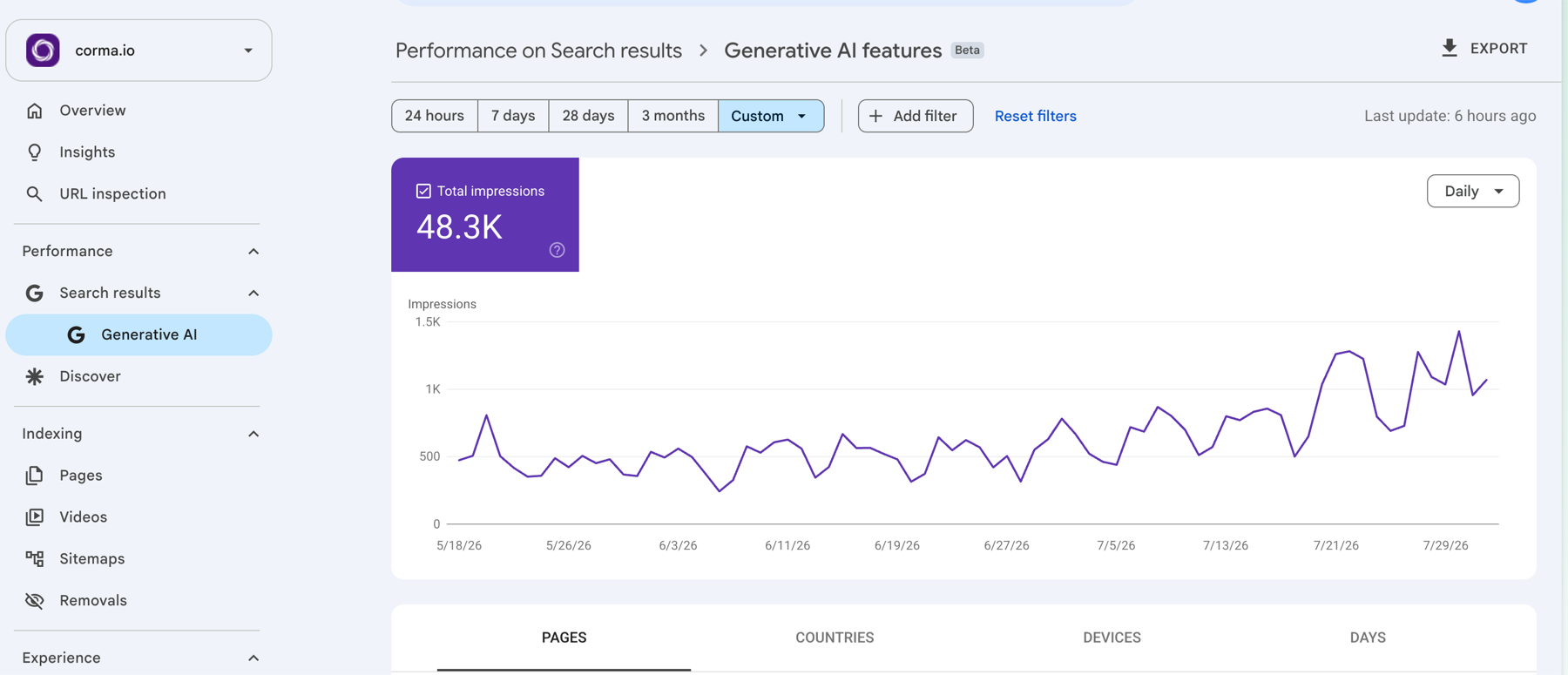
It also lifted the channels Corma already had. Since buyers verify with an assistant before they book anything, fixing the answer improved what happened to the visitors arriving from Google in the first place. Same traffic, better conversion, because the second opinion stopped contradicting the pitch.
Beyond the numbers, the team saw:
- Steady presence on priority prompts where Corma had been absent, including comparison questions that name the incumbents.
- More accurate descriptions of the product. Early answers that did mention Corma often got the details wrong. Fixing the underlying sources fixed the description.
- Better first calls. Prospects who come through assistant research arrive understanding the category, with a shortlist already in their head. That changes what the call needs to do.
- A rhythm the team can repeat: measure, find the gap, publish or correct the source, measure again.
“Organic was already a good channel but we saw the traffic from Google stagnating as people were starting to use AI engines to find tools, especially in the B2B context. We needed to understand where we were at and start from scratch. Refine helped us from the start to understand how we were positioning and then giving us everything to build a strong GEO presence. Today, no matter what engine you ask, Corma will be prominently displayed and we have a stronger than ever flow of GEO inbound prospects.”
 Nikolai Fomm
COO & Co-Founder, Corma
Why It Worked
Three things separate this from a content programme with the word GEO stuck on the front of it.
Measurement came before production. Corma had a baseline across five engines before publishing a single thing for GEO. That baseline is what let the team credit movement to specific work rather than to time passing, and it is the step almost everyone skips because it delays the visible output by a few weeks.
The work went where the citations were. In a category like this the instinct is to publish more. The better move was improving the handful of third-party sources the engines already treated as authoritative. It is unglamorous work, which is exactly why most competitors leave it alone.
Being new stopped being a handicap. Assistants reach for the best-corroborated answer, not the oldest company. A 2023 vendor with current, consistent evidence across the right sources can push past an incumbent whose material has gone stale. And it holds, because the same measurement loop catches it the moment it starts slipping.
The takeaway
Filing GEO next to SEO as another channel undersells it. Buyers check whatever they found on Google against an assistant before they commit, so the answer an engine gives about you decides whether the traffic you already pay for turns into anything. Corma measured that answer, fixed the sources feeding it, and got a third of its inbound out of the exercise.
Short on time? Have an assistant summarise this page for you.